
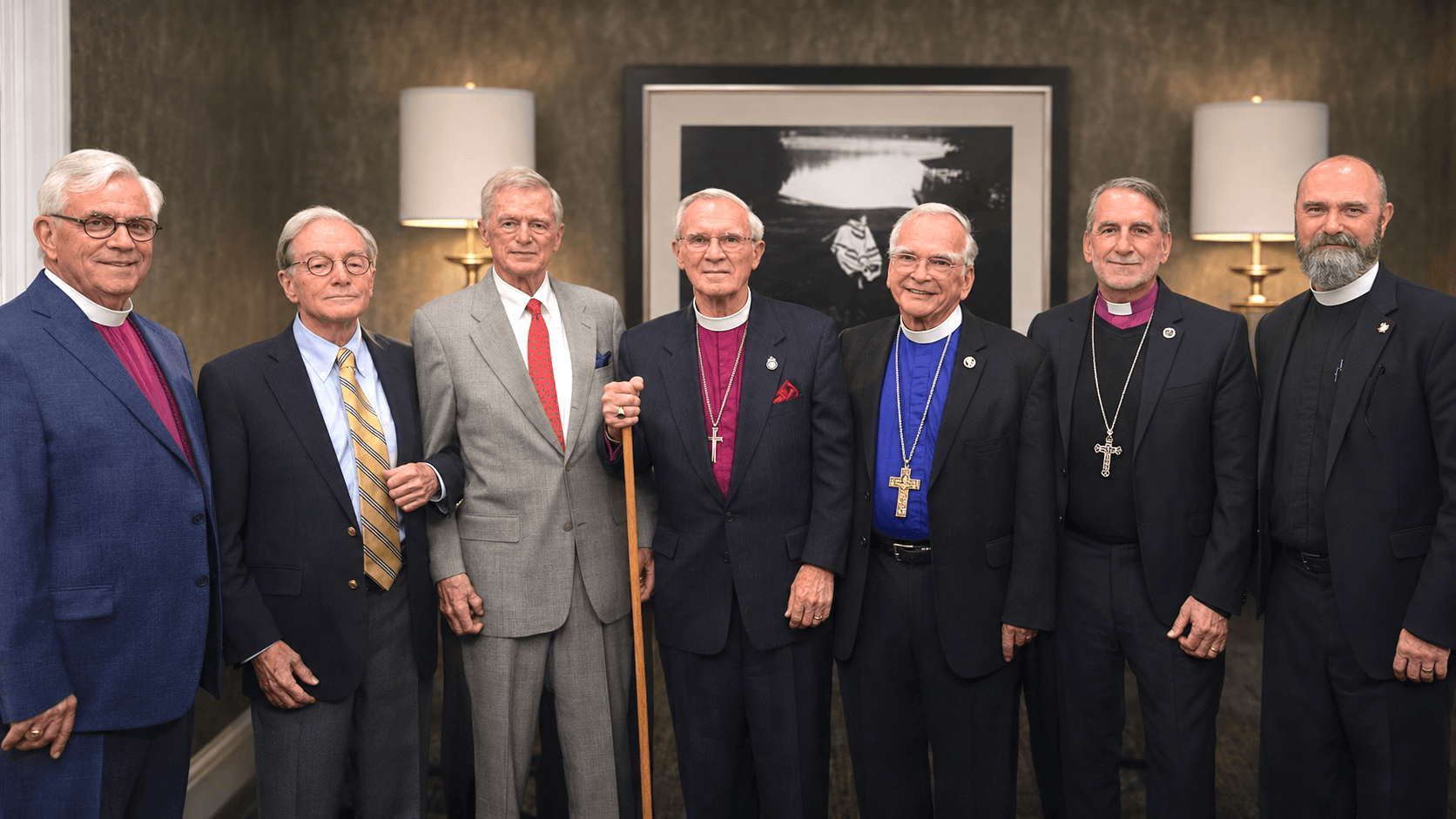
The American Anglican Council (AAC) gathered in Atlanta on October 27 for an evening of fellowship, thanksgiving, and celebration, honoring those whose faithful service helped shape the organization while looking ahead to a new season of leadership and ministry. Held in conjunction with the AAC’s fall Board of Trustees meeting, the special dinner brought together trustees, ministry leaders, and invited supporters to recognize the relationships, generosity, and shared convictions that sustained the Council for more than three decades.
Hosted by the Rev. Canon Mark Eldredge, the AAC’s President, the evening was an opportunity to celebrate the organization’s history while reaffirming its commitment to strengthening orthodox Anglicanism for generations to come. Following dinner, the Rt. Rev. David Anderson invited Archbishop Emeritus Foley Beach, Bishop of the Anglican Diocese of the South, to offer prayers for those being honored and for the AAC’s leadership as the organization enters this new chapter. Archbishop Beach was joined at the gathering by his wife, Allison. Archbishop Emeritus Robert Duncan was also in attendance, bringing together two former Primates of the Anglican Church in North America for the occasion.
A central part of the evening was the recognition of former Trustees Bill Bugg and Tom Hall, whose longstanding service, generosity, and commitment to the AAC have contributed significantly to its mission over the years. Bishop Anderson introduced both men for special recognition, reflecting on their contributions to the AAC and their enduring commitment to the Church. Each was honored through remarks and a special presentation expressing the organization’s gratitude.
Although unable to attend in person, former AAC President Bishop Phil Ashey sent a video greeting from California, recalling his years of friendship and shared ministry with Bugg and Hall. His reflections offered another reminder of the personal relationships and faithful partnerships that have been foundational to the AAC’s work.
The evening also included recognition of Bishop Anderson and his wife, Marianne, for their extraordinary dedication to the Council. Having served as President from 2001 to 2012 and, subsequently, as Chairman of the Board, Bishop Anderson helped guide the AAC through some of the most consequential decades in modern Anglican history. He now continues his service as Chairman Emeritus. The gathering also celebrated the Rt. Rev. Clark Lowenfield’s assumption of the chairmanship of the Board of Trustees, marking an important leadership transition.
Together, these recognitions reflected a larger story of faithful service, one that stretches from the AAC’s earliest efforts to defend biblical orthodoxy within Anglicanism to its present work of strengthening the life and mission of the Church. For more than 30 years, the American Anglican Council stood in defense of orthodox Anglican faith and practice. Through theological controversy, ecclesiastical realignment, and the formation of the Anglican Church in North America, the AAC worked alongside faithful Anglicans to preserve and advance the biblical convictions at the heart of the Anglican tradition.
That work remains essential. As the AAC enters a new season, its mission also calls for renewed attention to the health of the Church it labored so faithfully to defend. Preserving orthodox Anglicanism is not enough if its churches and leaders are not equipped to flourish. Clergy need encouragement, care, and a deeper grounding in Anglican identity and practice. Congregations need healthy structures, effective leadership, and renewed commitment to discipleship and mission. Dioceses and church leaders need sound governance rooted in biblical principles and faithful Anglican order. These are not separate concerns from the AAC’s historic mission; they are a natural continuation of it. Addressing those gathered, Bishop Lowenfield captured this vision for the organization’s future: “We ran to the sound of the battle for so many years, but now there’s a battle for health, mission, and growth that we are committed to running to. It’s for this moment that the AAC is here to serve.” Through its ministries of clergy care, church revitalization, and healthy governance, the AAC is increasingly focused on equipping Anglican leaders and congregations to grow in Gospel faithfulness.
The October gathering was an opportunity to give thanks for the people, relationships, and shared convictions that sustained the American Anglican Council for more than three decades. The sacrifices, generosity, and leadership of those who came before helped establish the foundation upon which the AAC continues to build. As it enters this new season, it does so with deep gratitude for those who faithfully served, with thanksgiving for the friendships and partnerships that continue to sustain its work, and with hope for all that God has yet to accomplish through its ministry.