When the Martyrs’ Day Statement was issued on October 16 of last year, my immediate reaction was that it reminded me of the United States’ Declaration of Independence. When the Declaration of Independence was issued on July 4, 1776, it did not come out of nowhere. It followed years of attempts by the American colonists to work with the King of England to correct the wrongs they believed they were experiencing. They explained it this way in the Declaration itself:
“Prudence, indeed, will dictate that Governments long established should not be changed for light and transient causes; and accordingly all experience hath shewn, that mankind are more disposed to suffer, while evils are sufferable, than to right themselves by abolishing the forms to which they are accustomed. But when a long train of abuses and usurpations, pursuing invariably the same Object evinces a design to reduce them under absolute Despotism, it is their right, it is their duty, to throw off such Government, and to provide new Guards for their future security.–Such has been the patient sufferance of these Colonies; and such is now the necessity which constrains them to alter their former Systems of Government.”
I’m sure there were colonists who were frustrated that it took so long to finally make that declaration. On the other hand, there were many colonists—known as loyalists—who were upset that the declaration was made at all. Some wanted the colonies to wait longer, hoping England would eventually change. Others believed they should remain loyal to England no matter what. So for some it took too long, and for others it came too soon. Yet either way, the Declaration only came after years of trying to bring change from within the existing governing structures. In many ways, the Martyrs’ Day Statement came about in a similar way.
It has now been more than two decades since The Episcopal Church “tore the very fabric” of the Anglican Communion when it approved the consecration of a practicing homosexual man as a bishop. Since that time, there has been tireless work to try to “mend the tear.” But the governing structures of the Anglican Communion have done little to make things better. In fact, not surprisingly, progressive leaders have continued to push matters further in the same direction. Finally, after years of patience and attempts at reform, the leaders of GAFCON said that enough was enough. They made a declaration that the Global Anglican Communion must move forward apart from the failed governing structures that have proven unable to address these issues. Reordering had become necessary.
I will admit that I find myself in the camp of those asking, “Why did it take so long?” But regardless of how long it took, the moment has arrived.
If we continue the analogy, the United States was not truly established on July 4, 1776. That date was simply a key moment in a much longer process of becoming a new nation. The colonies still had to fight and win the War of Independence, at tremendous cost. After that, they had to establish a new form of government, which itself proved to be a long and messy process. They first adopted the Articles of Confederation, which ultimately proved inadequate. That led to the creation of the Constitution, but even that required a difficult ratification process among the states, which was not completed until 1790. And then, after all of that, they realized more work was needed and added the Bill of Rights in 1791, fifteen years after the Declaration of Independence. Major, history-shaping change like that takes time.
In many ways, the Global Anglican Communion now finds itself at the beginning of a similar kind of process. GAFCON and the Global Anglican Communion are only at the early stages of what will likely be a long period of development as a reordered Anglican Communion takes shape.
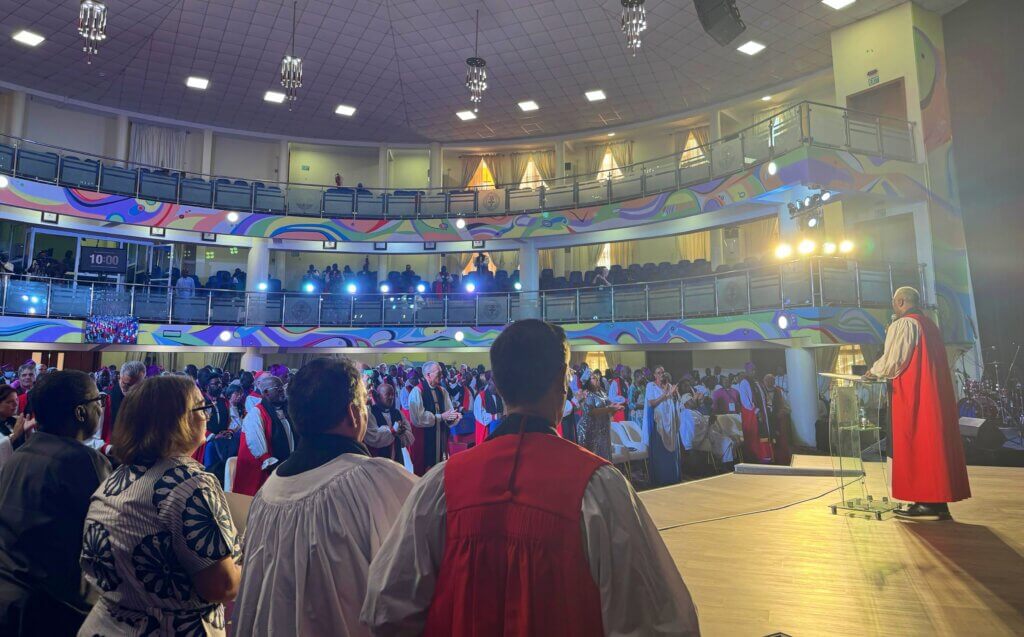
Having just attended the G26 gathering in Abuja, Nigeria, I was struck by how much the moment felt like the Second Continental Congress, where the early structures of American governance began to take form. One of the most significant developments was the decision to dissolve GAFCON’s previous governing body, the Primates’ Council, and establish a new Global Anglican Council. In that way, the Global Anglican Communion becomes more like a representative democracy, which gives a voice to disciples of Jesus from every level of the Church!
It truly is a new day. What is emerging is a Global Anglican Communion no longer dependent on the structures tied to the theological trajectory of The Episcopal Church and the See of Canterbury. Instead, we are seeing the beginnings of a reordered, biblically faithful Anglicanism that many believers have prayed and longed for over many years.
At the same time, it would not surprise me if further adjustments are needed as this new structure takes shape. There are still questions about how the Global Anglican Council will function and how the life of this newly reordered Communion will develop. Just as the founders of the United States worked for many years to refine their system of government, the Global Anglican Communion will likely continue working through the details of its new structures. After all, reordering a 500-year-old communion cannot be fast, easy, or perfect from the start. Major historical shifts rarely are. Change of this magnitude takes time.
I sometimes imagine that a hundred years from now, if the Lord has not yet returned, someone will write about the reordering of the Global Anglican Communion in a church history book. What we are living through today may be summarized in just a few pages, or perhaps a single chapter. A process that spans decades may seem brief to future readers, just as the founding of the United States can seem quick when we read about it today. But for those living through it at the time, it was a long and often messy journey.
That perspective helps me see the present moment more clearly. The reordering of the Global Anglican Communion is a process, and in Abuja at the G26 gathering we saw meaningful steps taken in the right direction. Leaders have built the kind of global, biblically faithful Anglican fellowship that many of us have prayed and worked toward for decades. There may still be improvements to make, but what has begun is something worth celebrating.
For that, we give thanks to the Lord. I look forward to continuing to walk this path together and to working alongside our brothers and sisters across the Global Anglican Communion in the years ahead. In the meantime, let us give thanks that God has raised up a biblically faithful global Anglican family, something many believers have prayed and labored for over many years.
Praise the Lord!