
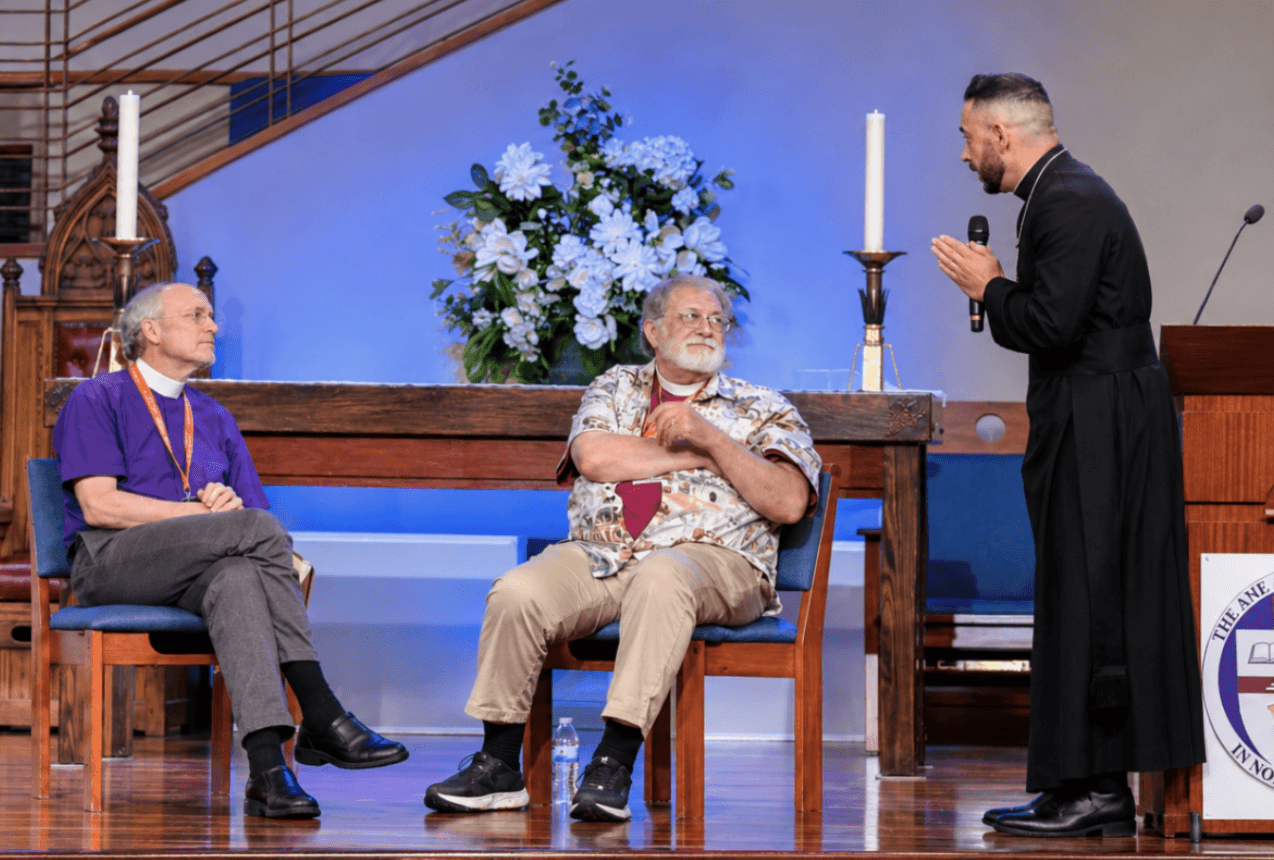
What an encouragement to take part in a diocesan synod focused on our desperate need for God the Holy Spirit! The Diocese of Western Anglicans held its annual synod in mid-October in Orange County, California, gathering leaders from almost 40 congregations and missions in seven Western states. Diocesan Bishop Phil Ashey centered the gathering on our need for the Holy Spirit’s power, from Luke 24:49.
Bishop Phil is best known for his work in global Anglican governance, having led the AAC for many years until his consecration 18 months ago. Less well known is his passion for the work of the Holy Spirit. His short video series, “Fire in the Fireplace,” is well worth your time and can be viewed here.
At the synod, Bishop Phil shared that he received the baptism in the Holy Spirit at age 12 under the preaching of renewal pioneer and Episcopal priest Dennis Bennett, and at that moment also received healing: greatly improved eyesight. That is the sort of power the Holy Spirit makes available to those who believe the New Testament promises are for today. Bishop Phil preached that when we look at ourselves, we see limited capacity. Just before his ascension, Jesus knew his disciples needed to be clothed with power from on high (Luke 24:49), so He told them to wait in the city until the Holy Spirit came. The Spirit came at Pentecost, and those early disciples went on to make more disciples, praying boldly with signs and wonders following. Within a few hundred years, they had changed the world.
Bishop Phil named three all-too-familiar symptoms of powerlessness in our churches. 1) Pervasive rationalism – lots of talk, with little application to living as Jesus did. 2) Lecture-centered worship meetings. Jesus typically spoke briefly, immediately demonstrated God’s power, then debriefed his disciples. 3) Downplaying experience. We assume supernatural things happen in Africa, but not much here anymore. Bishop Phil called this Christianity without power. By contrast, we need to share with each other what God is doing among us. Holy Spirit power comes from believing it is given to us, receiving it, and demonstrating it in faith, expecting God to move.
I had the privilege of preaching on Holy Spirit empowerment: Jesus’ delegation of both authority and power to us (Luke 10:19; Mark 16:15-18; Acts 1:8). We see little power partly because we haven’t understood or acted upon our delegated authority to heal the sick and command demons to flee. That reticence typically comes from an Enlightenment worldview that conditions us to expect failure when we pray. The remedy is to believe what the Bible says and do it, repeatedly, until you see results. We acknowledged the wounding that has too often come from bad practice associated with this theology. My exhortation: Don’t let the abuse of spiritual gifts be an excuse for their disuse. The remedy for bad teaching and bad practice is not disuse, but good teaching and proper use, with testing and oversight within biblical and pastoral boundaries. It takes time and care to train, correct, and oversee lay people in the gifts, and I’ve found it’s worth it.
Bishop Thad Barnum, a guest from the Diocese of the Carolinas, preached three messages on the power of the Holy Spirit, with the passion and prophetic boldness I always enjoy in his preaching. He said that we’ve been oppressed by metrics of growth, where Jesus becomes a means to an end, for our own glory. Jesus should always be the end and purpose of what we do! He said there’s too much fear of the Holy Spirit in our churches; some pastors don’t want him around, because they think he will mess things up! In Revelation 3:20, Jesus stands at the door of the lukewarm church and knocks. If Jesus is outside, so is the Holy Spirit. He then preached Galatians 3:7, saying that our outward clothing reflects what’s happened inside us. We are to make no provision for the flesh and its lust. The Holy Spirit is indispensable! He is God. He cannot be relegated to a stream of the church. We all desperately need Him.
Every plenary and workshop focused on empowerment by the Holy Spirit, and after each one people received prayer ministry for power, boldness, and healing, in keeping with Jesus’ way of ministering: proclamation, then demonstration; word, then works. I heard many words of encouragement about our time together and testimonies of God’s work in people’s lives. One person reported a dramatic emotional healing, which his wife later confirmed. At the very end of the Synod, the congregation gathered around Bishop Phil and layed hands on him for healing of his hip. Since then, he has been able to walk without any assistance!
Bishop Phil shared his hope to see the Holy Spirit moving in every church in the diocese. In Q&A, some clergy worried that he was requiring every church to “be charismatic.” Bishop Phil responded pastorally, clarifying that such practice was an invitation, not a mandate. “The Holy Spirit wants to surprise us,” said Bishop Phil, “and in whatever liturgical expression of Prayer Book worship that we have, can we begin to offer ways for the Holy Spirit to move among us?” Biblical ministry of the Holy Spirit is needed by all of us, whatever style or stream we identify with.
After hearing these messages, one priest of the diocese who had never considered himself charismatic opened his heart and asked to receive whatever the Holy Spirit wanted to give him. He testified to the whole gathering that God gave him a totally new experience: his first vision of Jesus. In his mind’s eye, he saw Jesus standing right behind Bishop Phil as he preached, head bent and palms clasped in prayer. This was a marvelous encouragement to that priest and to all of us who heard it.
We all need more of the power of the Holy Spirit. When we seek him first and are open to his gifts, he shows up in remarkable ways. Even so, Come, Holy Spirit!