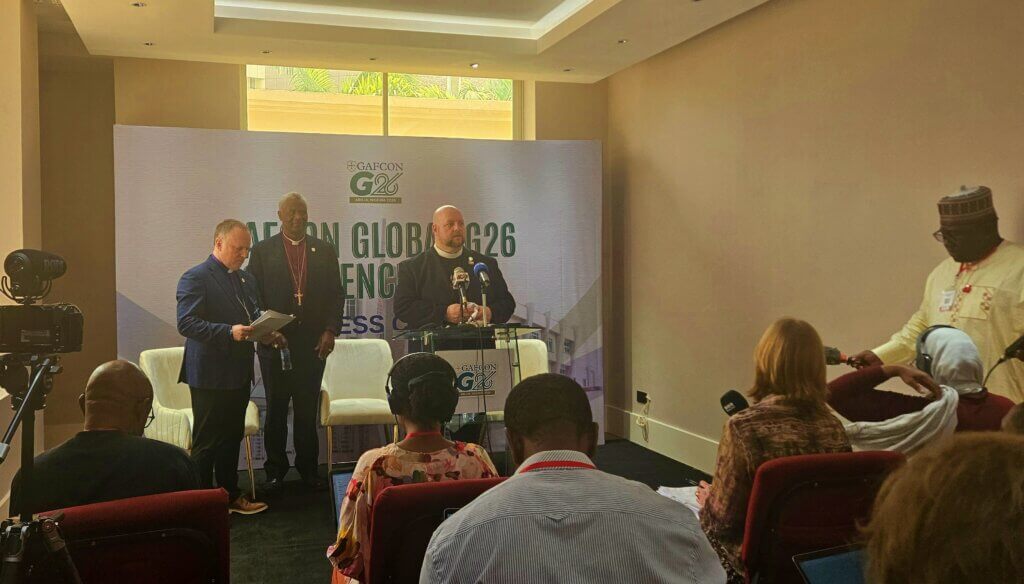
Leaders of the GAFCON movement announced a significant development in the ordering of global Anglican leadership this week, dissolving the longstanding Primates Council and establishing a new governing body known as the Global Anglican Council, which is to lead the Global Anglican Communion. The newly formed council will include primates, advisors, and guarantors drawn from bishops, clergy, and lay leaders across the global church, each with full voting privileges. The move represents a shift toward a more conciliar structure intended to reflect the Communion’s wider leadership. As part of this transition, the council unanimously elected Laurent Mbanda, Archbishop of Rwanda, to serve as Chairman of the Global Anglican Council. Miguel Uchoa, Archbishop of the Anglican Church in Brazil, was elected Vice-Chairman, and Paul Donison will continue to serve as General Secretary.
In a letter announcing the decision, Donison explained that the Primates Council, which had guided the GAFCON movement since its founding in 2008, has now intentionally stepped aside in order to broaden participation in the stewardship of the Global Anglican Communion. “In a world where most organizations and individuals are concerned about keeping power and authority,” Donison wrote, “the GAFCON Primates Council has made an unprecedented decision to share its stewardship of the Global Anglican Communion.”
The creation of the Global Anglican Council reflects that commitment to shared leadership. While primates will continue to play a central role, the council now incorporates a wider range of voices from across the church, including bishops, clergy, and lay leaders. During a press conference following the announcement, leaders emphasized that the development should be understood not as a departure from Anglican identity, but as an effort to strengthen the foundations of global Anglican fellowship. “This is not about leaving the Anglican Communion,” leaders explained. “It is about the Anglican Communion reordered around the Bible.”
Central to that vision remains the Jerusalem Declaration, which continues to serve as the theological foundation for partnership within the GAFCON movement. Leaders reiterated that affirmation of the declaration remains a requirement for participation in the Global Anglican Communion. A notable feature of the restructuring is the decision to move away from the traditional Anglican language of primus inter pares, or “first among equals,” when speaking of the Council. While previous GAFCON communications had occasionally used that language in describing primatial leadership, the council determined that the newly established conciliar structure should be accompanied by new terminology as well.
Under the new structure, the chairman will serve as the chair of the expanded council rather than as the head of a primates body. Leaders explained that the change reflects both the broader composition of the council and the desire to avoid replicating older models of centralized authority. Questions during the press conference also addressed the relationship between the Global Anglican Communion and its Council and the historic leadership role associated with the Archbishop of Canterbury. Leaders clarified that the Council recognizes its own chair as the leader of its work, rather than looking to Canterbury for that role in any way.
At the same time, they stressed that Anglican identity is not defined solely by its historic connection to England. Instead, Anglicanism is rooted in a shared commitment to Scripture, the historic creeds, and the classical formularies of the Anglican tradition. Leaders also emphasized that the theological disagreements that shaped the GAFCON movement ultimately concern the authority of Scripture itself. “The issue before us is fundamentally theological,” one leader explained. “It is not primarily about sexuality or gender but about the foundations on which the Communion is built.” Those issues, leaders noted, reflect deeper questions regarding biblical interpretation and the doctrinal direction of the church.
The announcement was welcomed by many participants as an important step in the continued development of global Anglican structures capable of representing the majority of Anglicans worldwide. At the same time, the announcement prompted a number of questions from those present. Among the most frequently raised were the precise role of the chairman, how members of the Global Anglican Council will be selected, and how the authority of the new body differs from the former Primates Council in practice. Participants also raised questions about how the Global Anglican Communion will relate to existing Anglican structures and how it may respond to proposals currently being discussed elsewhere, including the Nairobi-Cairo proposals associated with the Anglican Consultative Council. Another question concerns how the new structure will engage with provinces and dioceses that remain formally connected to Canterbury but continue to hold to historic Anglican teaching. Leaders noted that participation in the Global Anglican Communion remains open to those who affirm the Jerusalem Declaration, including the Church of England and elsewhere.
The first term of the newly elected chairman will run until the next GAFCON assembly in Athens in 2028, when the Council will hold a new election under the developing governance structure.
For many observers, the announcement marks a significant stage in the maturation of GAFCON. What began in 2008, as a gathering of confessing Anglicans seeking to defend the authority of Scripture, grew into a global movement now attempting to build durable structures for Anglican fellowship rooted in the historic faith of the Church. Time will tell how the newly established Global Anglican Council will function and how its leadership in the Communion will relate to existing Anglican structures. Important questions remain about representation, authority, and the council’s relationship to Canterbury-connected provinces, but the direction of travel is unmistakable. For many Anglican leaders across the Global South and beyond, the task is no longer simply to protest theological drift within the Communion, but to construct a framework of leadership capable of sustaining orthodox Anglican witness for generations to come.