
On September 11, 2001, thousands of airline passengers boarded planes expecting to arrive at destinations around the world. The terrorist attacks that morning, however, changed everything. With North American airspace closed, dozens of international flights were diverted to the small town of Gander, Newfoundland, leaving thousands of frightened and bewildered travelers far from home. What happened next became an extraordinary story of hospitality and compassion. The people of Gander opened their homes, churches, and hearts to complete strangers, providing food, shelter, clothing, and comfort during one of the darkest moments in modern American history.
More than 25 years later, that remarkable act of neighborly love provided the setting for an important message on the Great Commandment, evangelism, and the mission of the Church. During a recent visit to Newfoundland, American Anglican Council (AAC) President Canon Mark Eldredge preached at St. Matthew’s Church in Gander, drawing upon the community’s experience during September 11 to illustrate the Christian calling to love one’s neighbor and bring others safely home to God through Jesus Christ.
Renewing and Revitalizing God’s Church
Mark’s visit to Newfoundland began in St. John’s, where he served as a keynote speaker at the annual synod of the Anglican Diocese of Canada. The gathering centered on the theme of growing and building God’s Church, with particular attention given to church planting and church revitalization. Wednesday’s program was devoted largely to Mark’s teaching on the principles of revitalization. His first emphasis was that genuine church revitalization must begin with spiritual renewal. “There is no revitalization without renewal,” he explained, calling church leaders back to their first love and to dependence upon the Holy Spirit for the work of ministry. He then addressed the importance of recovering a vision for evangelism based on the Great Commission that reaches all with truth and love. In an increasingly post-Christian culture, churches must move beyond simply hoping people will come through their doors and instead embrace a missional approach to reaching their communities. Finally, Mark introduced the concept of church health through the five VITALS, emphasizing the importance of balance across the essential dimensions of a healthy and thriving congregation.
The response was encouraging. Throughout the remainder of the synod, Mark met with rectors and church leaders to discuss how the Revive process might be implemented in individual congregations. The diocese also purchased and distributed 175 copies of the Revive book, providing participants with a practical resource to continue the conversation in their own churches. Most importantly, the visit opened up opportunities for continued partnership between the AAC and Anglican churches in Canada.
A Different Kind of Revitalization Lesson
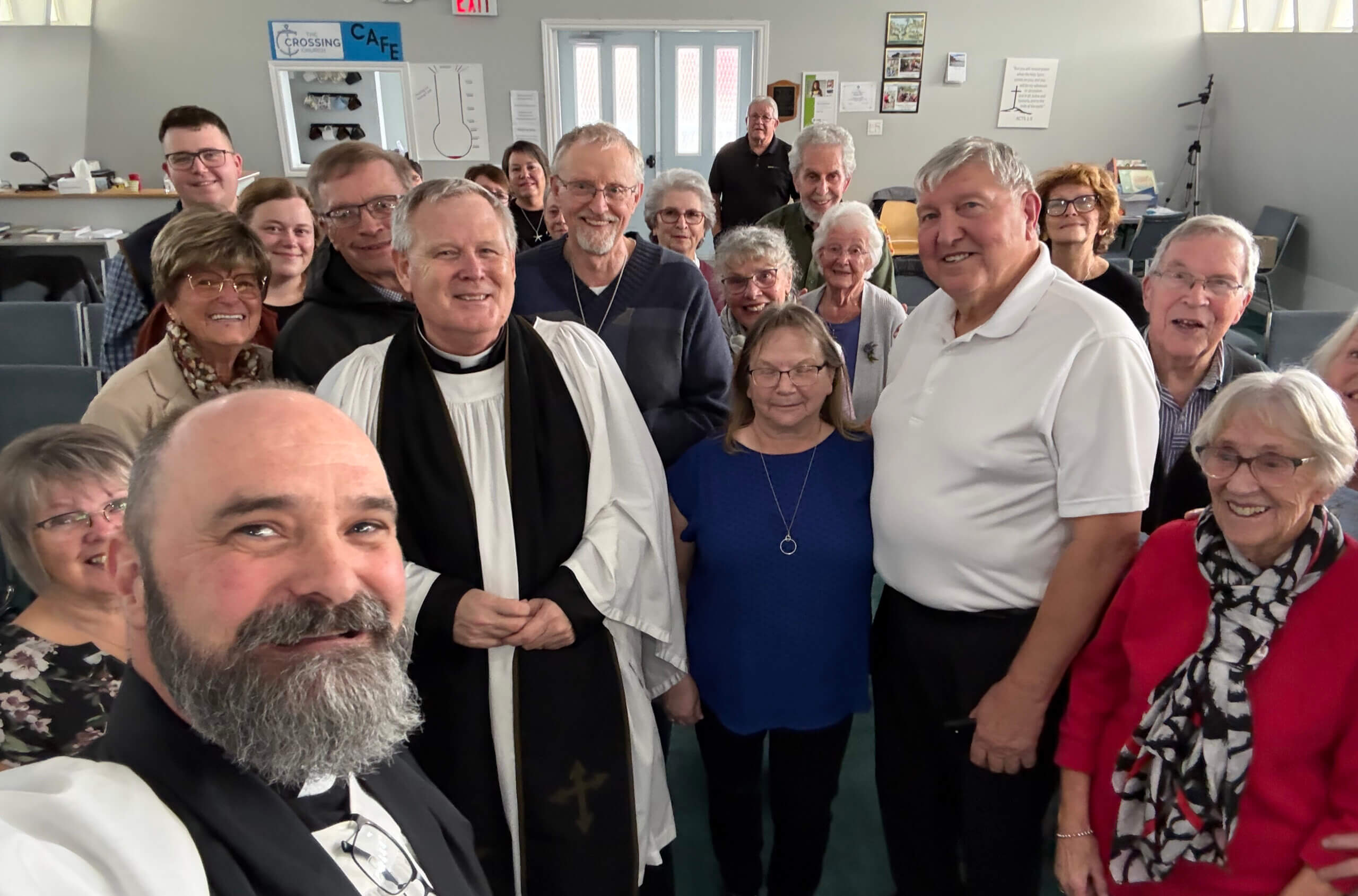
Following the synod’s conclusion on Friday, Mark traveled three and a half hours to Gander with Canon Howard Edwards, executive director of the Anglican Diocese of Canada, and members of the local church. On Saturday morning, he led a condensed Revive workshop at St. Matthew’s Church, encouraging parishioners to consider how they might reach their neighbors and engage more intentionally in mission within their community. Following lunch, the congregation gathered for a Eucharist celebrated by Canon Edwards, with Mark preaching the sermon based on the scripture readings of the day.
The appointed Gospel reading was Matthew 22, in which Jesus identifies the two great commandments: to love God with all one’s heart, soul, and mind, and to love one’s neighbor as oneself. For Mark, preaching this passage in Gander presented a remarkable opportunity. Drawing upon the events of September 11, he reminded the congregation that the passengers diverted to Gander had begun their journeys with plans and destinations. Through an act of evil, those plans were shattered. Suddenly, these strangers found themselves lost, frightened, and uncertain of what lay ahead. The people of Gander responded by putting the Great Commandment into action.
Canon Mark took the analogy further, connecting the experience of those stranded passengers to humanity’s spiritual condition. Human beings were created in God’s image for fellowship with Him, but through sin, humanity departed from that intended relationship, becoming lost and separated from God. “The mission of the Church,” Mark explained, “is to love others enough to help them find their way home.” He turned to 1 Peter 3, which calls Christians to share the hope within them with gentleness and respect, and particularly to verse 18, which declares that Christ suffered for sins, the righteous for the unrighteous, to bring us home to God. Just as the people of Gander cared for strangers who were unexpectedly diverted from their journeys, Christians are called to extend the love of Christ to those who are spiritually lost, pointing them toward the One who brings them safely home to God.
Learning from Those Who Lived It
For Canon Mark, the most moving part of his visit came through conversations with parishioners who participated in Gander’s response to September 11. Of the approximately 30 people gathered at St. Matthew’s for the Revive workshop, at least ten were directly involved in caring for stranded passengers. Some recalled receiving urgent requests to bring bedding, pillows, and other supplies to the church. Others remembered setting up cots to accommodate unexpected guests. One woman described spending the week working in the church kitchen, preparing meals and feeding those who suddenly found themselves in need. Their stories were told without fanfare. When the need arose, the community simply rallied together and did what needed to be done.
For Mark, these encounters brought an unexpected humility to his own role as preacher. “I felt inadequate to be preaching about loving your neighbor to this group of Newfoundlanders who embodied loving your neighbor so perfectly,” he reflected. “I felt like I should be the one sitting down and listening. In many ways, they could teach me so much more than I could ever teach them.”
It was a fitting conclusion to a week devoted to church revitalization through building loving relationships. After days of teaching about spiritual renewal, evangelism, and the importance of becoming a missional church, Mark encountered a community that demonstrated what it means to love one’s neighbor in extraordinary ways. The people of Gander didn’t wait for strangers to come through their church doors. When the need arose, they went out to meet them, offering the love and hospitality of Christ to people far from home and in need of rest. And perhaps that’s one of the most important lessons in church revitalization: that the love of Christ isn’t merely something to be taught and preached, but something to be lived out in the communities we’re called to serve, wherever they may be, however far away.