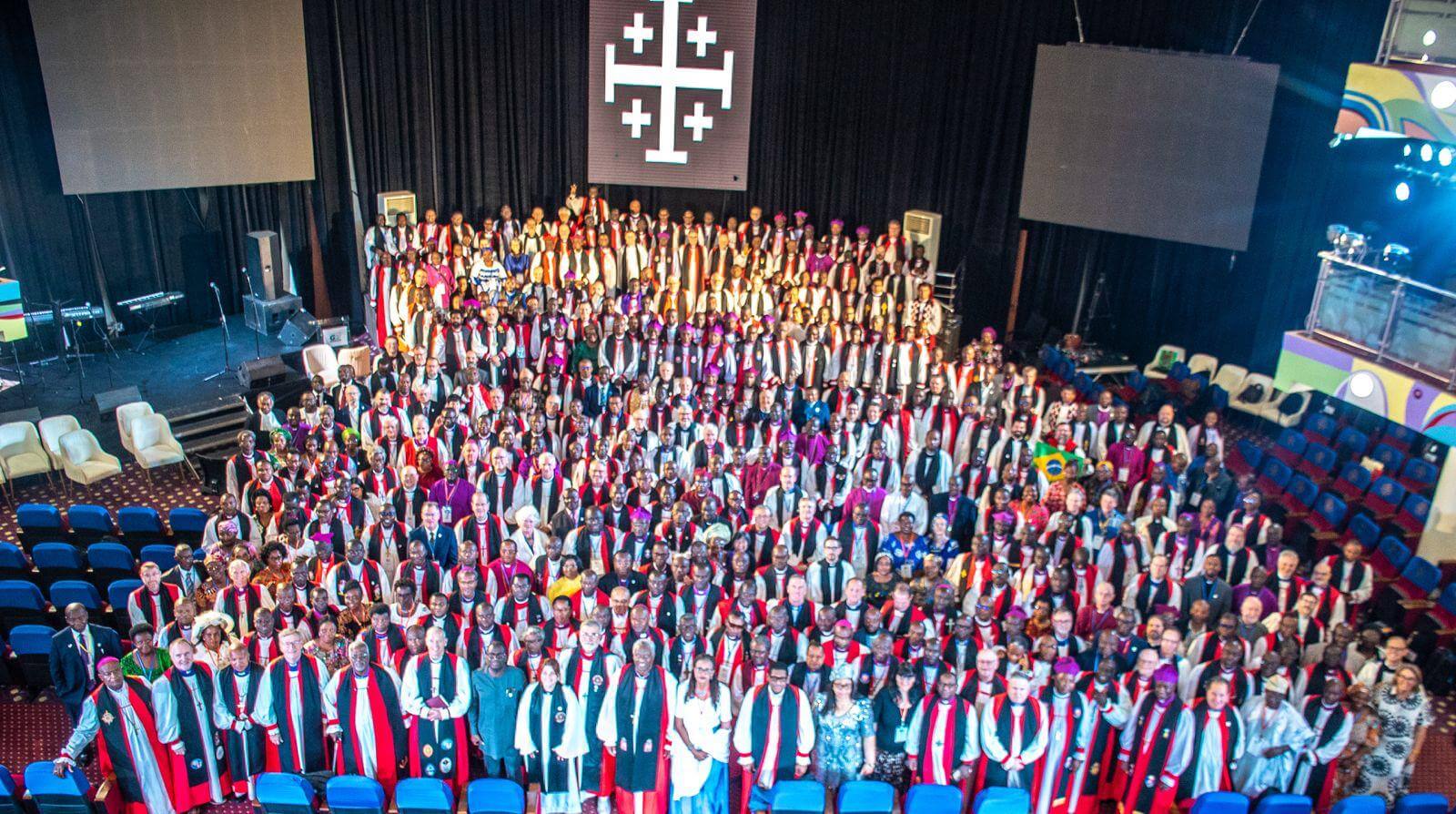
The fourth and final day of the GAFCON Council in Abuja brought the week’s discussions to a close with a renewed call for biblical faithfulness, culminating in the release of the Abuja Affirmation and a closing service at the Cathedral Church of the Advent, the cathedral of the Anglican Church of Nigeria.
The morning began with a Bible study from 1 John, chapter 2, led by the Rt. Rev. Richard Condie, Anglican Bishop of Tasmania. Preaching from the apostle John’s warning about false teachers, Bishop Condie reminded those gathered that the challenges facing the Church today should not come as a surprise. John described false believers as a sign of “the last days,” referring to them as the spirit of antichrist. “We are here because of the antichrists among us,” Condie said, emphasizing that false teachers and false believers have always been a feature of Christian discipleship. He cautioned that the danger is not limited to those outside the orthodox faith. Church leaders themselves must guard their hearts against denying Christ. “We deny him when we expect deference and walk in pride as leaders,” he said. “We deny him when we are taken in by money given to us by heretical teachers. We deny him when we live in immorality while claiming leadership in the Church.” Though the motivations may differ, Condie warned, the temptation remains the same: to abandon Christ.
Drawing from John’s teaching, he urged the Church to remain steadfast in four ways: to remain in the truth, remain in the Word, remain in Christ, and remain in the Spirit. The Church’s confidence ultimately rests not in its leaders or structures, but in Christ himself, who continues to build his Church. “It is the last hour,” Condie said. “On that day we will not stand before synods, or parliament, or secular courts. We will stand before the Lord Jesus Christ, the judge of heaven and earth. And how will we be found on that day?”
Following the morning study, council participants spent several hours working through the final draft of the statement that would summarize the outcome of the week’s deliberations. Bishops and leaders consulted together on edits and revisions as the document took its final shape. During this time, the Rt. Rev. Julian Dobbs shared the story of the formation of the Anglican Church in North America (ACNA). Reflecting on the early years of that province, he expressed gratitude to the global Anglican leaders gathered in Abuja for the support they offered during the ACNA’s formation and for their continued encouragement. “I say thank you to you,” Dobbs told the assembly, noting that the growth and vitality of the province in North America was strengthened by the support of orthodox Anglicans around the world.
The business portion of G26 concluded with the public reading of theAbuja Affirmation, a statement outlining the vision of the newly inaugurated Global Anglican Communion. The communiqué reaffirmed the authority of Scripture as the foundation of Anglican doctrine and declared that genuine communion must be grounded in shared confession rather than institutional structures. It also announced the establishment of the Global Anglican Council, which will provide leadership for the Global Anglican Communion. The statement called for principled disengagement from the traditional Canterbury-based Instruments of Communion, arguing that those structures have failed to uphold biblical teaching. At the same time, the affirmation invited provinces, dioceses, and congregations that assent to the Jerusalem Declaration to participate in this reordered global fellowship committed to proclaiming Christ faithfully to the nations. (You can read more about the statement here.)
After tea, participants traveled to the Cathedral Church of the Advent for the Council’s closing service. The procession into the cathedral reflected the tone of the week’s conclusion. The purple, red, and blue vestments of the choir, clergy, and bishops processed into the sanctuary in a moment that felt markedly different from the opening night. Where there had initially been anticipation and wonder about how the week’s discussions might unfold, the final service carried a sense of relief and gratitude. The gathering came before God not so much asking for direction, but giving thanks for what had been accomplished and expressing hope for the future.
The readings reflected the central theme that shaped the entire council. From Joshua 24, the Prophet Joshua calls the people of Israel to choose whom they will serve. The epistle from Philippians 2 urged believers to adopt the humility of Christ, while the Gospel reading from Matthew 28:16-20, the Great Commission, reminded the Church of its calling to proclaim the gospel to the nations.
Preaching from Joshua’s challenge to “choose this day whom you will serve,” the Primate of Rwanda, the Most Rev. Dr. Laurent Mbanda, who was elected earlier in the week as Chairman of the Global Anglican Council, reflected on the significance of the gathering. He thanked the Church of Nigeria for hosting G26 and spoke about the responsibility now facing the global movement. “Choose, commit, go, and do,” Mbanda said. He encouraged the gathering that there was no other way; they cannot stand on the sidelines.
Reflecting on the history of the GAFCON movement, from Jerusalem to Nairobi, Kigali, and now Abuja, he reminded those gathered that God has guided the fellowship through many challenges. Yet the question facing the Church remains the same. “Who or what are the gods we are rejecting?” Mbanda asked, naming the temptations of cultural approval, the spirit of the modern age, spiritual laziness, and the elevation of human reasoning above divine revelation. If the Church serves those gods, he warned, it cannot serve the living God.
Looking ahead, Mbanda urged Anglican leaders to move beyond theological clarity toward active discipleship. Faithful preaching, evangelism, church planting, and raising orthodox leaders for the next generation must now define the Anglican movement’s work. “We have clarified our theology,” he said. “Now we must multiply disciples. The future has come, and we are standing on it.”
The service concluded with the Holy Eucharist, a reminder that despite the many nations, cultures, and roles represented in the cathedral, those gathered share one faith in Christ and one conviction that the Word of God must govern their lives. Around the Lord’s Table, the divisions and pressures that often shape the wider Anglican landscape were set in their proper perspective. What ultimately binds the Global Anglican Communion is not institutional structure or historical prestige, but a shared submission to the authority of Scripture and a common calling to proclaim the gospel of Jesus Christ.
As the GAFCON Council came to a close in Abuja, that shared commitment to biblical faithfulness and global mission remained at the center of the movement’s path forward. The conversations of the past days about leadership, structure, and the future ordering of Anglican life were ultimately grounded in that deeper reality. For many gathered, the hope expressed throughout the week was that the decisions taken here will strengthen the ability of orthodox Anglicans to stand together, support one another across provinces, and bear clear witness to Christ in a rapidly changing world. Time will reveal how these developments take institutional form, but the spirit of the council made one thing clear: the resolve to remain rooted in the historic faith of the Church and to walk forward together in that conviction is stronger than ever.