
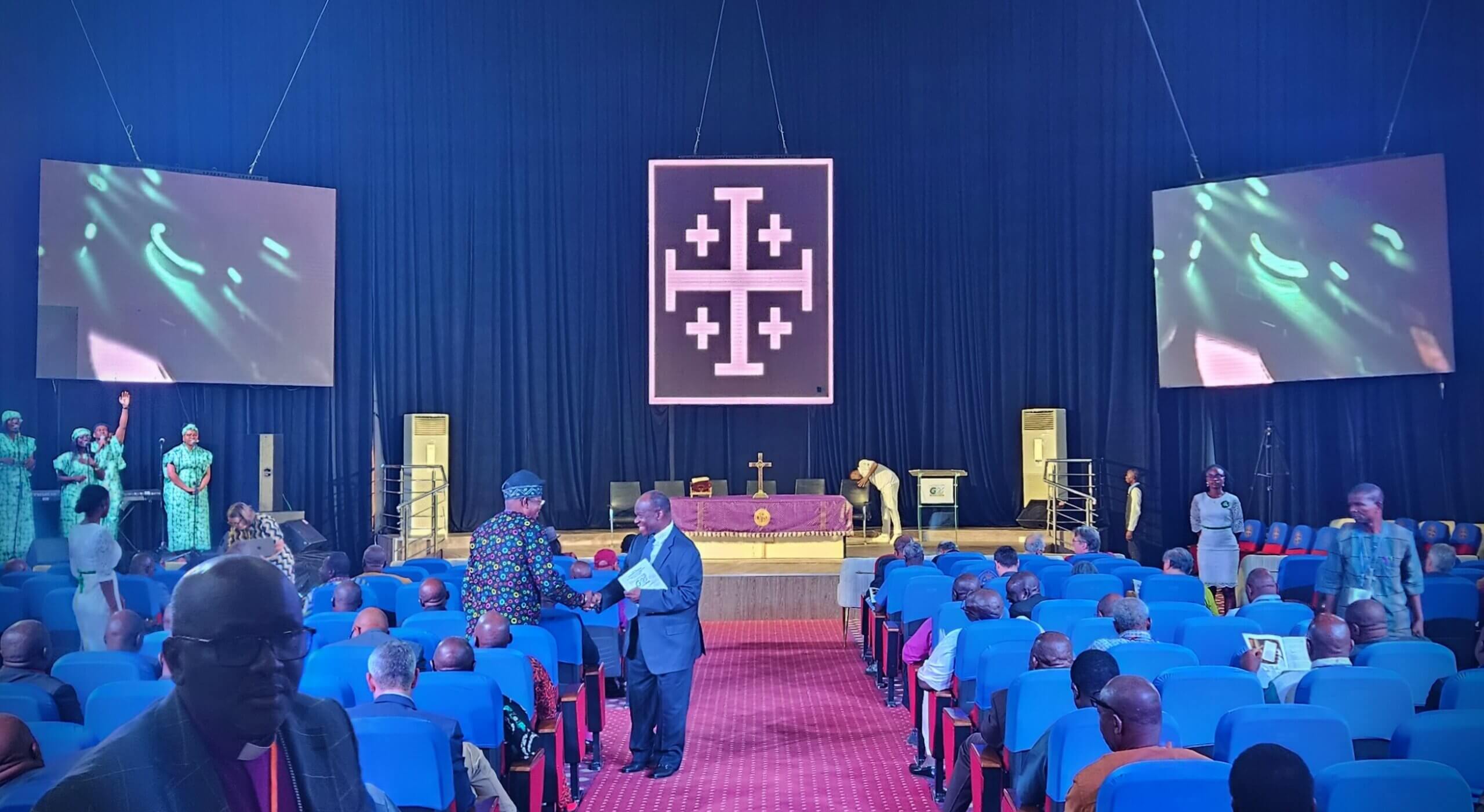
Bishops and Anglican leaders from across the Global Anglican Communion gathered for the second day of the GAFCON Council in Abuja with a clear and recurring theme: the future of Anglican unity must be grounded in the authority of Scripture and the historic faith of the Church. As discussions continue about the reordering of global Anglican structures, the day’s preaching and teaching emphasized the spiritual foundations that shaped the GAFCON movement from the beginning.
The morning began with worship and a sermon from the Rt. Rev. Dr. Emmanuel Egbunu, Bishop of Lokoja and Archbishop Emeritus of the Province of Lokoja. Preaching from the book of Joshua, Bishop Egbunu warned that indecision is dangerous for the people of God and called the gathered leaders to take a clear stand for the faith. Drawing on the history of the Reformation and the witness of the Oxford martyrs, he reminded the congregation of Hugh Latimer’s famous words before his execution in 1555: “We shall this day light such a candle in England as I trust shall never be put out.” The church today, he said, stands in a similar moment, where faithful Christians must be willing to say again, “Here I stand.”
Reflecting on Joshua, Bishop Egbunu noted the repeated emphasis on boundaries, pointing out that the word “boundary” appears dozens of times in the biblical account of Israel’s inheritance. These boundaries, he explained, carry spiritual significance for the church today. “It was the need to stay within biblical boundaries that gave birth to GAFCON,” he said, describing the movement as a call to authentic, Christ-exalting Christianity. God, he reminded the congregation, tolerates no idols, whether ancient or modern.
The bishop challenged those present to begin with personal conviction, calling them to renewed faithfulness in their own lives and households. Faithfulness, he said, may require putting aside unhealthy relationships and refusing to compromise with ideas that undermine the authority of Scripture. The Anglican Communion’s current crisis, he suggested, is fueled in part by a reluctance to confront such compromises.
The morning plenary sessions continued the theme of unity rooted in truth. Greetings were brought by representatives of Christian organizations in Nigeria, including a message from a representative of the Roman Catholic Church, Fr. Michael Nsikah Umoh, who spoke about the importance of pursuing unity in truth among churches that seek to remain faithful to the gospel. A representative of the Christian Association of Nigeria also offered a goodwill message to the gathering.
The first major teaching session, titled, The Road to Reordering, began with Bishop Paul Donison, General Secretary of GAFCON. Preaching from the Beatitudes in Matthew chapter five, Bishop Donison described the upside-down character of the Kingdom of God and urged the church to remain humble as it moves forward in a season of significant change. Addressing the history of Anglican structures, he noted that the Instruments of Communion were themselves relatively recent developments in Anglican history. Their purpose had been to help guard the faith and maintain unity among the provinces of the Communion. In recent decades, however, many within GAFCON believe those structures failed to fulfill that role.
Donison emphasized that the movement does not see itself as departing from Anglican teaching. Instead, he pointed to Lambeth Resolution 1.10 as evidence that the position held by GAFCON remains consistent with what the Anglican Communion itself previously affirmed regarding biblical teaching on human sexuality.
He also clarified that the gathering in Abuja had been planned long before the recent election of Dame Sarah Mullally as Archbishop of Canterbury. The concerns raised by many in the Communion, he stressed, are not about the fact that the new archbishop is a woman. Instead, they center on the persistence of false teaching within the Church of England, including her prior support for positions that depart from historic Christian teaching on sexuality and no clear indication that the current trajectory will change. At the same time, Donison acknowledged that the decision to elevate Mullally to the See of Canterbury highlights a deeper problem. In choosing a leader whose theological commitments reflect positions rejected by much of the Global South, the Church of England has demonstrated a troubling lack of awareness of the wider Communion. For many Anglicans around the world, the appointment raises serious questions about whether Canterbury can still serve as a meaningful focus of unity for a global church that holds sharply different theological convictions.
Throughout the rest of the day, speakers repeatedly returned to the Martyrs’ Day Statement issued in 2025, which declared that “the future has arrived” for faithful Anglicans seeking a renewed structure for global fellowship. Bishop Onesimus Asiimwe of Uganda expanded on this theme in a presentation reflecting on the East African Revival, a movement that transformed much of Anglican Christianity in East Africa during the twentieth century. That revival, he said, emerged in response to a church that had become overly ritualistic and nominal, and it called believers back to personal repentance, obedience, and renewed commitment to Christ. He compared the role of GAFCON in the wider Communion to the role that revival played in East Africa. Just as the revival renewed the spiritual life of the church in that region, he suggested that GAFCON represents a similar call to renewal for Anglicans worldwide.
Quoting from earlier GAFCON statements, Bishop Onesimus reminded the council that the movement long envisioned a future in which the Bible is restored to the heart of the Communion. “Today,” he said, “that future has arrived.”
Several speakers also reflected on what they described as the end of colonial patterns of church leadership. As Anglican churches in Africa, Asia, and Latin America have grown rapidly, they have increasingly sought to shape the life of the Communion according to their own theological convictions and mission priorities, apart from the shadow of a colonial and often patronizing West. Bishop Alfred Olwa, also of Uganda, emphasized that the unity of the church cannot survive if its foundation is constantly shifting. The church, he said, does not construct its own foundation but receives it from God in Christ and in the revelation of Scripture. For that reason, he argued, the true basis of Anglican unity cannot rest in colonial Western-dominated institutional structures. “It is the Bible,” he said, “not Canterbury, not Lambeth, not the Instruments.”
The afternoon continued exploring the history and challenges of the existing Communion structures. The Rt. Rev. Flavio Adair Torres Soares, of the Anglican Church of Brazil, reviewed the development of the Canterbury-centered institutions and described how churches in parts of the Global South often felt unprotected when theological controversies emerged within the wider Communion. Another presentation from the Rt. Revd. Clement Sun Oo, Bishop of the Diocese of Pyay, Myanmar, reflected on the theme that communion requires confession, emphasizing the need for shared doctrine as the foundation of fellowship.
By the end of the day, through the speakers, worship, fellowship, prayer, and discussion sessions among the attendees, a consistent message emerged: this present moment is not simply a conflict within Anglicanism but is a turning point in which new structures must emerge to support a renewed global fellowship centered on Scripture and historic Anglican teaching. For churches connected to the Global Anglican Communion, the conversations taking place in Abuja represent an effort to strengthen a worldwide partnership committed to the authority of Scripture, the historic formularies of the Church, and the mission of proclaiming the gospel. Faithful Anglicans in North America have watched these developments closely over the years, recognizing that the future shape of the global Anglican movement will affect churches across every continent, including our own Anglican Church in North America. As the G26 continues its deliberations, the emphasis on biblical faithfulness and global cooperation suggests that the movement is seeking not merely structural change but a renewed confidence in the mission of the Anglican Church and the future of a worldwide fellowship grounded in the Word of God.