
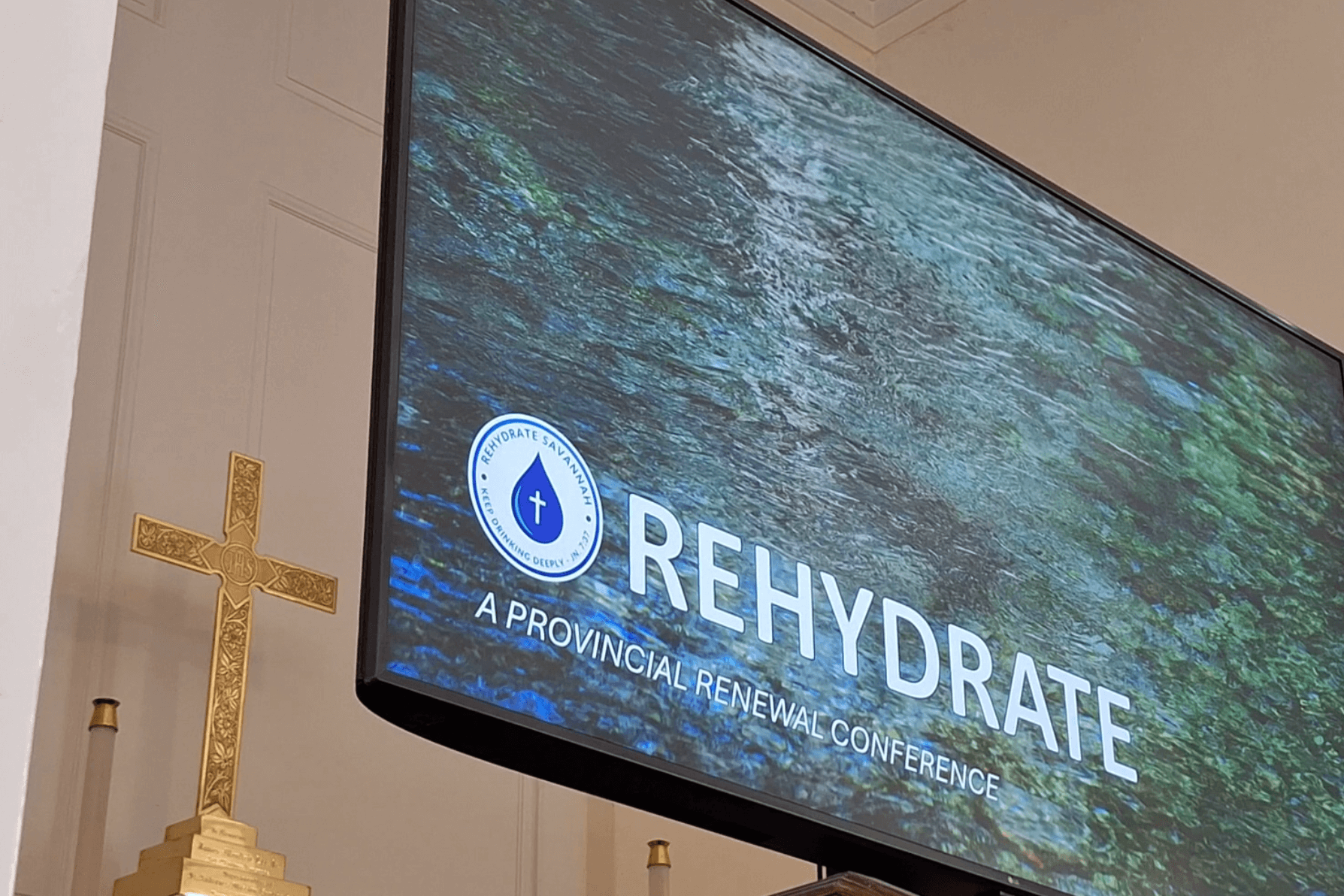
The opening evening of Rehydrate began with a shared meal and a shared recognition: renewal can’t be manufactured; it must be received.
Gathered at Christ Church, Savannah, GA, on Thursday evening, February 19, clergy and lay leaders from across the ACNA assembled first around dinner tables before moving into the sanctuary for worship and teaching. The setting was hospitable and unhurried. Conversation flowed easily over a meal of pork, vegetables, macaroni and cheese, and Black Forest cake. The warmth of the host church was evident, not only in its welcome but in the simple attentiveness of volunteers who served throughout the evening. But beneath this fellowship was a quieter awareness. Many in attendance are leaders who spend most of their time pouring themselves out for others. Some wore collars; some didn’t. There was a sense that many came not primarily to strategize or network, but to be strengthened themselves for the work ahead. That posture would shape the tone of the night.
Following dinner, the Rev. Canon Mark Eldredge welcomed participants and introduced the conference theme, “Living Water.” His framing was direct: there can be no revitalization without renewal. Structural reform, new initiatives, and creative programming cannot substitute for spiritual vitality. The health of the Church depends upon the health of her leaders, and the health of leaders depends upon whether they are drinking deeply from Christ Himself. Earlier in the day, Canon Mark quite literally experienced dehydration, experiencing first hand that when the body lacks water, clarity diminishes, strength wanes, and systems falter. The effects are cumulative and, if left unaddressed, debilitating.
Session One was titled “Stay Thirsty,” delivered by the Rt. Rev. Darryl Fitzwater, bishop of the Missionary Diocese of All Saints. Turning to John 7:37–39, where Jesus cries out, “If anyone thirsts, let him come to me and drink,” Bishop Fitzwater posed a searching question: how many Anglicans are not drinking the living water? The problem facing the Church, he suggested, is not organizational but spiritual. A dehydrated body cannot function properly; a dehydrated Church cannot flourish. We should all be thirsty, at some level or another, for what we really need.
His sermon moved through passages in Isaiah, contrasting judgment and promise. Isaiah 34 depicts desolation; Isaiah 35 answers with restoration and a “highway of holiness.” Renewal, however, is not sentimental. It requires repentance. Bishop Fitzwater warned that “false winds” have blown through parts of the Church, currents of emotionalism and the pursuit of spiritual experiences detached from the steady authority of Scripture. The Word of God, he reminded the congregation, is not confusing. When confusion prevails, the remedy is not novelty but clarity.
Using the image of a strong north wind, he called for discernment and cleansing. Without repentance, churches will not grow in depth or durability. Referencing the Church of Laodicea in Revelation, he noted the danger of losing one’s first love. The adoration of the Holy Trinity, he said, has waned in some places involved in charismatic renewal, replaced by an emphasis on feelings that may or may not reflect the work of the Spirit. Tears and physical sensation are not reliable measures of spiritual vitality; Scripture itself offers examples of intense emotion unaccompanied by obedience.
The center of renewal, Bishop Fitzwater argued, is the proclamation of the Gospel. In the Book of Acts, the Holy Spirit falls as Christ is preached. Acts 10 records that “the Holy Spirit fell on all who heard the word.” Truth declared becomes the conduit of grace received. Drawing from 2 Corinthians 1:9, he observed that seasons of weakness often teach the Church to rely not on itself but on “God, who raises the dead.” Even persecution in the early Church served to scatter believers outward, propelling mission rather than stifling it.
The sermon concluded not with urgency but with invitation. Bishop Fitzwater expressed a sense that the Lord desired to speak further and asked the assembly to wait quietly before Him. Several brief prophetic words were offered from the floor, each encouraging in tone and anchored in the assurance of God’s love. One exhortation urged participants not to leave without receiving the gift God intended for them during the gathering.
The response time that followed was measured and reverent. The Rev. Clancy Nixon invited those present to remain in their seats for silent prayer, while also making space at the rail for those who desired individual ministry. Bishops and prayer ministers, including leaders from partner ministries, were available. Soft piano and guitar accompanied the time without dominating it. The atmosphere reflected the very balance the sermon had called for: openness to the Spirit without emotional excess, and expectancy grounded in Scripture.
Several participants later shared that they had been deeply encouraged during this time of prayer. For leaders accustomed to carrying responsibility, the opportunity simply to receive ministry proved significant. Rehydrate’s first night did not attempt spectacle. Instead, it established a foundation. Renewal begins with thirst. It requires repentance, discernment, and the steady proclamation of Christ. It invites leaders not merely to labor harder but to drink more deeply. If Thursday evening set the trajectory for the days ahead, it did so with clarity. Before the Church can be revitalized, she must first be refreshed.