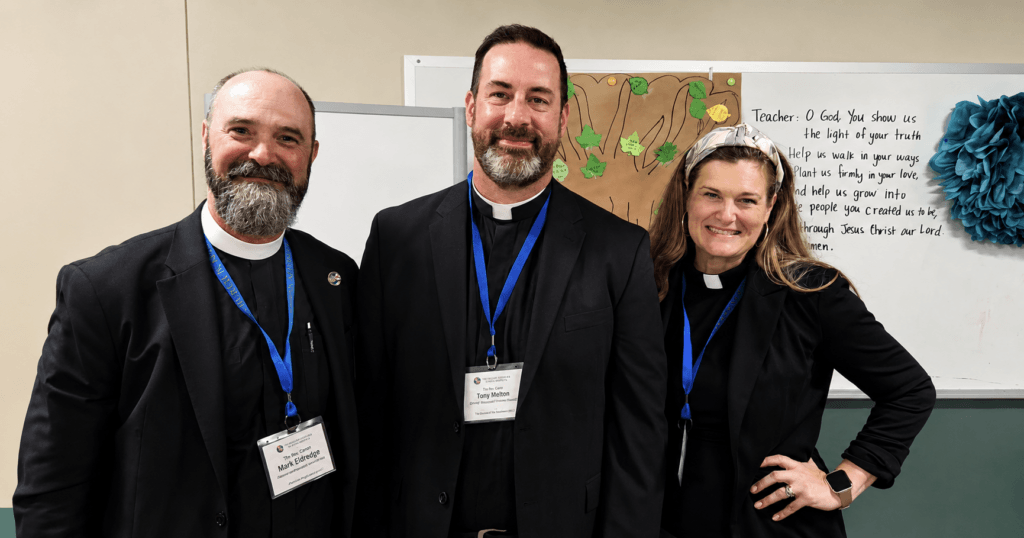
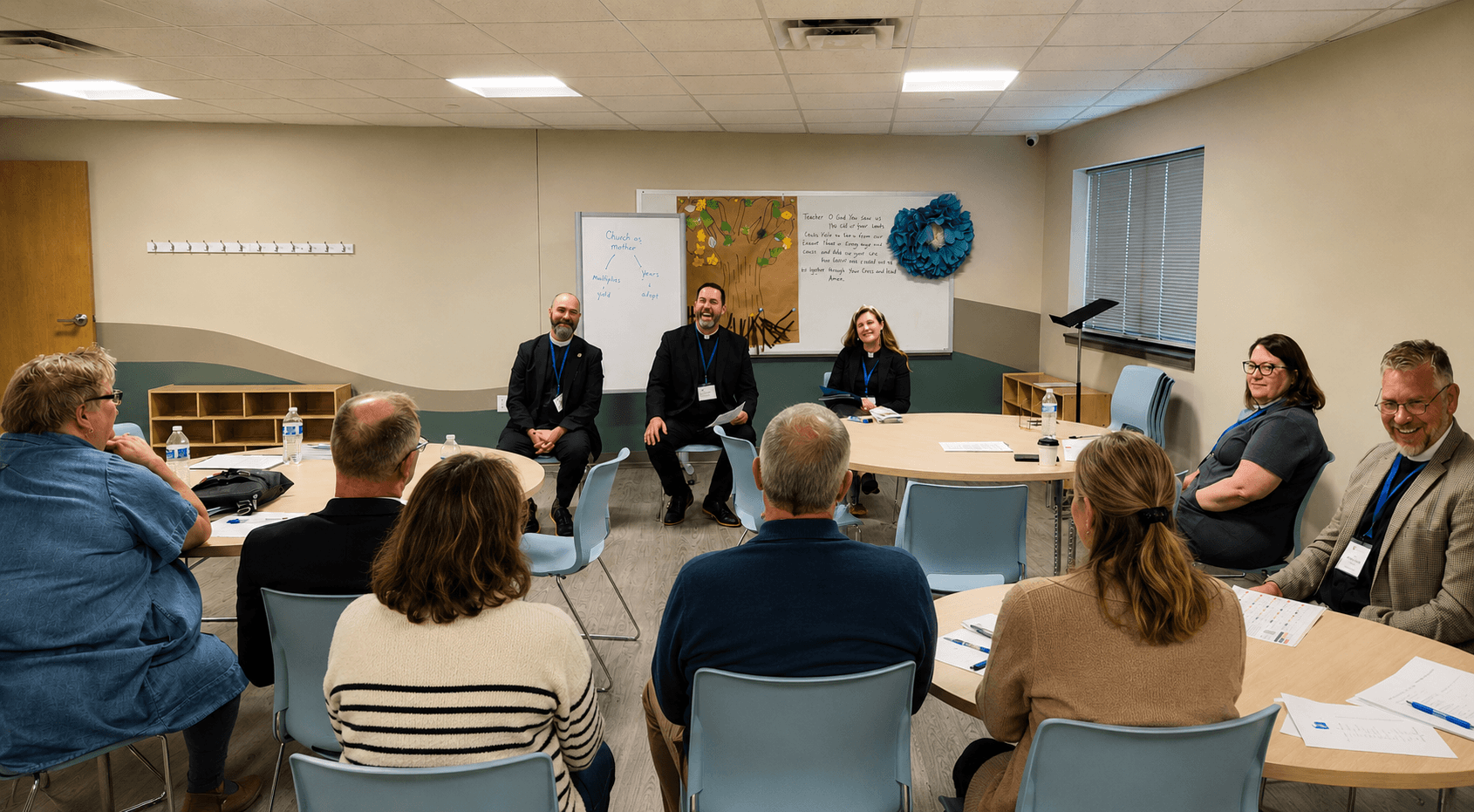
Church leaders attending Provincial Council 2026 were challenged to rethink church planting and revitalization through an ancient but often overlooked biblical image: the Church as mother. The workshop, “Fostering Healthy Churches through Planting and Revitalization,” was led by the Rev. Canon Tony Melton, Director of Always Forward; the Rev. Canon Mark Eldredge, President of the American Anglican Council; and Deacon Virginia Musselman, Director of the ACNA Women’s Leadership Network.
Melton opened the session by introducing the concept of the Church as mother, arguing that the Church needs missional metaphors that are deeply rooted in Scripture and Christian tradition. Drawing on the Church Fathers, including Cyprian and Augustine, as well as biblical images such as the New Jerusalem, the barren mothers of the Old Testament, and the woman of Revelation 12, he suggested that maternal imagery provides a compelling framework for mission and church growth.
“The Church as mother” emphasizes mercy, sacrifice, nurture, and the giving of life, he explained. It also helps highlight the gifts women bring to the mission of the Church and challenges congregations to move beyond self-preservation toward multiplication and new life. Melton noted that fewer than four percent of churches ever plant another church. A maternal vision of ministry, he argued, encourages congregations to become generative, giving themselves away for the sake of God’s kingdom rather than focusing solely on their own survival.
Building on that foundation, Canon Mark reflected on how the language of motherhood connected with his own work in church revitalization. While he admitted that the metaphor was initially unfamiliar to him, he found significant overlap with the way Revive approaches church health and renewal. For years, he used physical health as a framework for understanding church revitalization. Just as a healthy body naturally grows, healthy churches grow as they become more spiritually healthy through the work of the Holy Spirit.
He also drew on agricultural imagery, noting that growth cannot be manufactured through effort alone. “You can’t make a plant grow by talking to it or yelling at it,” he said. “If a plant isn’t growing, you have to understand what’s suppressing its growth and help it become healthy.”
Eldredge outlined Revive’s five vital signs of church health: vision for evangelism, intentional worship, transformation toward Christlikeness, authentic community, and lay mobilization through leadership development. Sharing examples from revitalization efforts across North America, he observed that many declining churches have become inwardly focused. In one striking example, a congregation admitted that its primary concern was not reaching the lost but avoiding closure. Recognizing that misplaced priority became a turning point in the church’s journey toward renewed health and mission.
Dcn. Virginia concluded the presentations by exploring how women can help the Church recover a more relational and nurturing vision of ministry. She suggested that churches can sometimes adopt business-oriented approaches to leadership, treating the church as an organization to manage rather than a family to nurture. Just as rectors can be viewed primarily as CEOs instead of spiritual fathers, congregations may overlook the maternal dimensions of church life. Musselman highlighted the often unseen work women perform through hospitality, relationship building, discipleship, and care for families. These relationships frequently become the pathways through which newcomers encounter and become connected to the Church. “When you bring women and men together, you get the whole picture of not only who God is but what a healthier church looks like,” she said.
The workshop concluded with table discussions that challenged participants to evaluate their own ministries through four practical lenses: Yearn, Adopt, Multiply, and Yield. Attendees reflected on how their churches can better reach the lost, invest in neighboring communities, develop new leaders, and sacrificially give away resources for the sake of new life and gospel growth. Together, the presentations offered a vision of church planting and revitalization rooted not merely in strategy, but in the life-giving identity of the Church herself: a mother called to nurture, multiply, and send forth new life into the world.
To learn more about the themes discussed in this workshop, listen to the latest episode of The VITAL Podcast, featuring a conversation between Canon Mark Eldredge and Canon Tony Melton on church planting, church revitalization, and cultivating healthy, mission-focused congregations. The episode is available online here, or by searching for The VITAL Podcast wherever you listen to podcasts.