
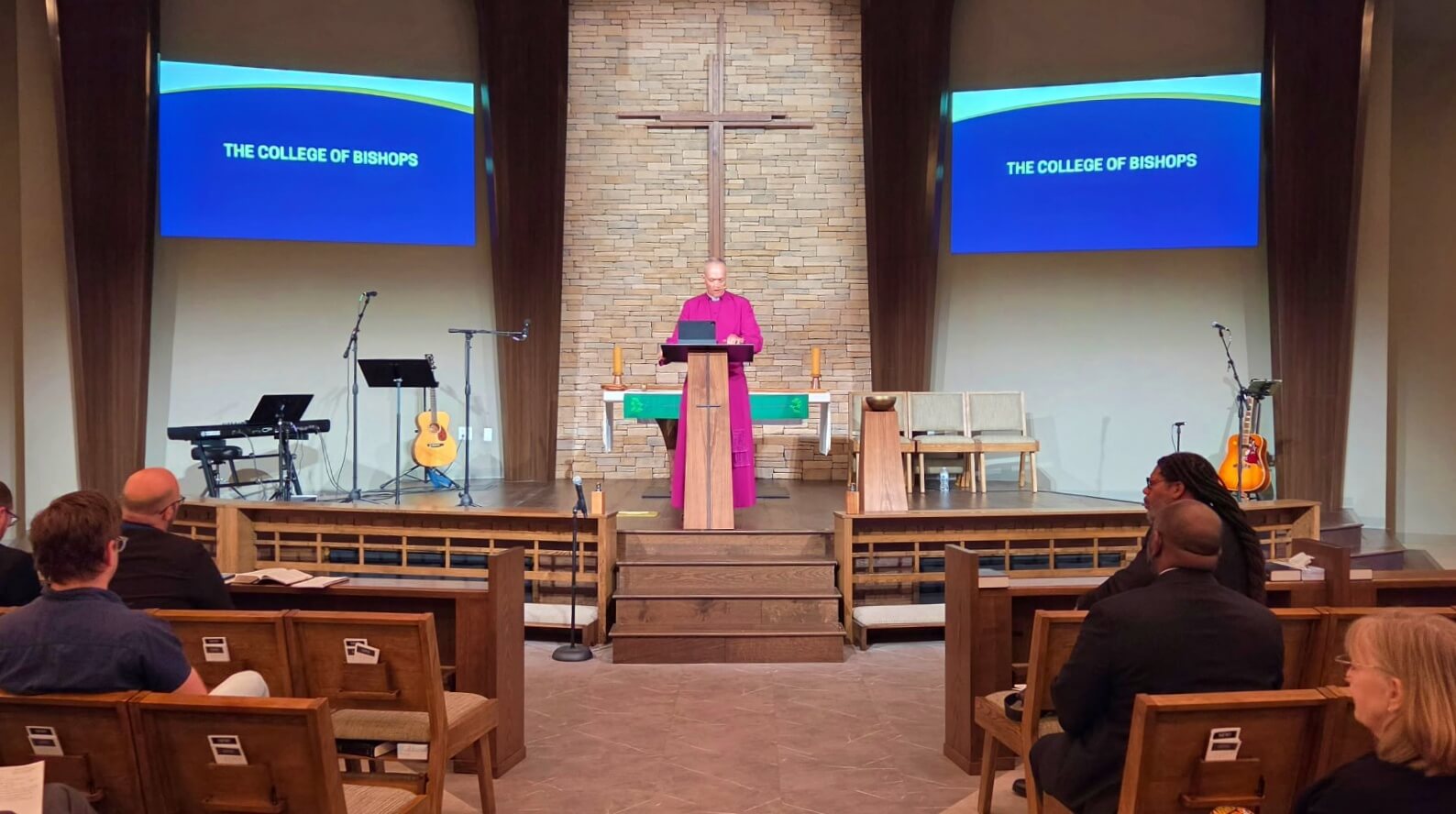
Following Morning Prayer, delegates to Provincial Council heard greetings from several church leaders before Archbishop Emeritus Bob Duncan introduced the Dean of the Province, the Rt. Rev. Julian Dobbs, for the Dean’s Address, who began by acknowledging the difficult season the Anglican Church in North America (ACNA) has endured. “We meet at a season, which, by any honest accounting, has tested our young province,” he said, pointing to recent challenges including the inhibition of an archbishop, the discipline of bishops, and the financial and organizational struggles facing some churches and dioceses.
But the Dean urged delegates not to view the Province solely through the lens of its difficulties. Alongside the challenges are signs of remarkable growth and God’s continued faithfulness. Congregations are being planted, average Sunday attendance is increasing in many places, and churches continue to experience both spiritual and financial provision. He highlighted encouraging developments across the Province, including growth in the Anglican Diocese of Canada and a steady stream of baptisms among both children and adults. Partnerships with institutions such as Trinity Anglican Seminary are helping equip leaders for future ministry and mission.
The Dean reminded delegates that the ACNA was never intended to become a heavily centralized institution. Rather, it was deliberately structured to support the work of dioceses and congregations in fulfilling their mission. “The fundamental agency of mission in this province is the local congregation,” he said, describing the principle as a constitutional commitment that continues to define the Province’s identity. When that commitment is forgotten, he warned, provincial structures become top-heavy while local congregations become weakened. For that reason, maintaining a clear focus on parish ministry remains essential.
To illustrate the point, Dobbs reflected on the ministry of the first Bishop of Liverpool, J.C. Ryle. Long before becoming a bishop, Ryle spent years planting churches, preaching the Gospel, and caring for souls in local parishes. Those experiences shaped the episcopal ministry that followed. In the same way, Dobbs argued, mission must remain the foundation upon which the Province builds its future.
Turning to the work of the College of Bishops, Dobbs reminded delegates that bishops bear the God-given responsibility of guarding the faith, unity, and discipline of the Church. The canons charge bishops with teaching, ordaining, disciplining, and maintaining the apostolic order received from Christ. Speaking personally, he offered a heartfelt defense of his fellow bishops. “I know the bishops of this province personally, and I know them to be godly men, seeking to serve Christ in a season of uncommon difficulty.” He described the burdens bishops often carry behind the scenes and urged delegates to make prayer for their bishops a regular part of their Christian lives. He stated, “There is no act of love you can give to your bishop more than constant, powerful prayer to the Father for your bishops.”
Dobbs also addressed the proposed revisions to Title IV, the Province’s clergy disciplinary canons. While acknowledging that no church enjoys spending time discussing misconduct and discipline, he emphasized that such work is necessary to preserve both justice and trust within the Church. Commending the proposed reforms to the delegates, he publicly thanked the Rev. Canon Andrew Rowell, Chair of the ACNA Governance Task Force and Director of Anglican Governance Ministries for the American Anglican Council, for his leadership throughout the process. He urged delegates not to leave Provincial Council without completing the work before them and approving the revisions.
Despite acknowledging ongoing disagreements within the Province, Dobbs repeatedly returned to the mission that unites Anglicans across jurisdictions and dioceses. “We must be honest about the fact that we don’t agree on many things at this point,” he said. “But beneath the differences, there is a deeper unity.” That unity, he argued, is not ultimately found in ecclesiastical structures or internal debates, but in a shared commitment to proclaiming the Gospel and reaching North America with the transforming love of Jesus Christ.
As examples, he pointed to the growth of a new Anglican community in Fargo, serving a region hungry for a sacramental and biblically faithful church, as well as the growing Hispanic populations throughout the United States and Canada who present significant opportunities for Gospel ministry. Though dioceses may approach ministry differently, the objective remains the same: to bring Christ to those who do not yet know Him and to plant Gospel-centered communities where people can worship the living God. “The lostness of North America is not a problem to be managed,” Dobbs said. “It’s a field white for the harvest.”
Looking beyond North America, Dobbs reflected on his recent participation in G26 in Abuja, Nigeria, and the Province’s place within the wider fellowship of orthodox Anglican churches around the world. “It is no small thing to know that we do not stand alone anymore,” he said. What once felt isolated in the early days of the ACNA has become a vibrant global partnership marked by shared conviction, mutual encouragement, and a common commitment to Gospel mission.
The Dean also took time to honor the chaplains serving throughout the Province. Their ministries often take them into places where traditional parish ministry cannot easily reach. “They carry Christ into places where Christ is needed and where He is least welcome at times,” he said. Particular recognition was given to the Rt. Rev. Jerome Jay Cayangyang, recently installed Bishop of the Jurisdiction of the Armed Forces and Chaplaincy. Dobbs noted that Bishop Cayangyang relinquished the opportunity to become an admiral in the United States Navy in order to answer God’s call to lead and support Anglican chaplains. “This is what costly Gospel leadership looks like,” Dobbs said. His remarks were met with a standing ovation from delegates.
As his address drew to a close, Dobbs expressed gratitude for the provincial staff who have supported him throughout the past seven months of leadership amid significant challenges. He then returned delegates to the words of St. Paul in Colossians, urging them to remain rooted in Christ above all else. In the midst of controversy, growth, challenges, and opportunities, Dobbs offered a simple but clear conclusion. The future of the Province will not ultimately be secured by structures, programs, or personalities. It will be found in Christ alone. As the Church faces both its present challenges and future opportunities, the call remains the same: to walk faithfully with Christ, trusting Him to guide His Church and accomplish His mission.