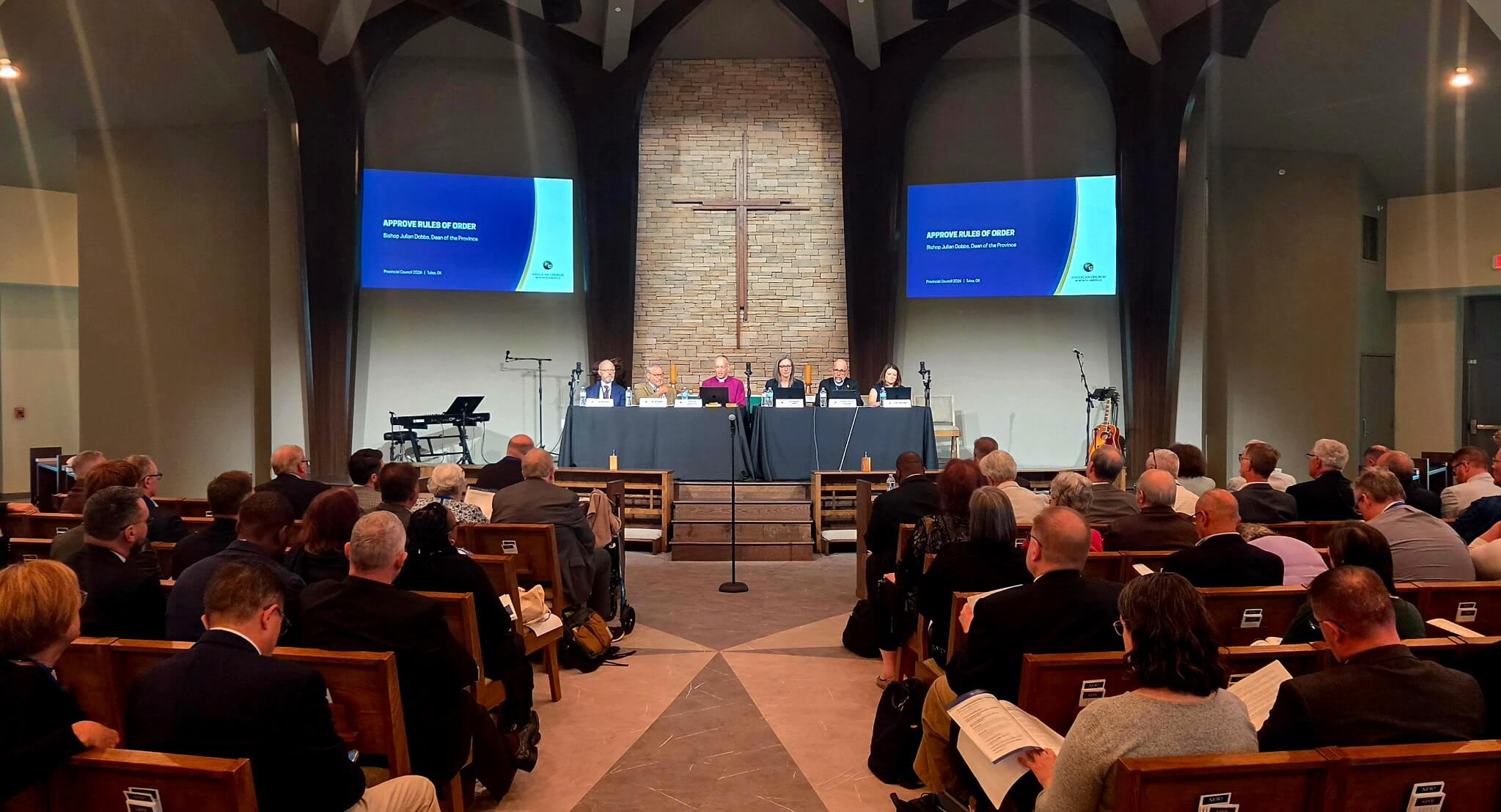
The second day of the 17th Provincial Council of the Anglican Church in North America (ACNA) was marked by a full schedule of worship, teaching, workshops, reports, and legislative action as delegates gathered at Cornerstone Anglican Church in Tulsa, Oklahoma. Throughout the day, attention was given to two important aspects of the Province’s common life. On one hand, delegates considered matters of mission, church planting, evangelism, and provincial growth. On the other, they addressed questions of governance, accountability, church discipline, and the structures necessary to sustain the life of the Church. Together, these discussions reflected the broad scope of Provincial Council and the responsibility entrusted to bishops, clergy, and lay delegates from across North America.
The day began with Morning Prayer led by the host congregation, Cornerstone Anglican Church. The Rev. Jon Odom, Rector of Cornerstone, delivered a brief message centered on St. Paul’s encouragement to the Corinthians to be led into a spacious place of unity and generosity toward one another, despite their differences. He reminded delegates that lasting unity cannot be achieved through compromise alone but must be grounded in a shared faith in Jesus Christ. As the Province continues to navigate challenges and disagreements, Fr. Odom encouraged those gathered to remember that reconciliation begins with a common commitment to Christ and His Gospel.
MORNING SESSIONS
Following Morning Prayer, delegates heard a testimony from the Rev. Canon Tony Melton, Director of Always Forward, the Province’s church planting initiative. Speaking passionately about the importance of church planting, Canon Melton described it as one of the clearest biblical and apostolic models for advancing the Gospel. “I believe church planting is one of the most biblically clear, apostolically modeled ways of bringing the Gospel always forward,” he stated. Drawing on stories from church planters across the Province, Canon Melton recounted examples of congregations stepping out in faith to establish new ministries and reach new communities. Again and again, he said, he has witnessed God’s provision when churches are willing to embrace risk and obedience. Looking toward the future, Melton shared a vision that extends beyond planting individual churches and seeks to cultivate a culture of multiplication throughout the Province. “Over the next ten years, I want to see every parish in the ACNA become a mother church,” he said. “Every church a mother.”
The morning session continued with greetings and reports from provincial leaders. Archbishop Emeritus Bob Duncan introduced the Rt. Rev. Julian Dobbs, Dean of the Province, who delivered the Dean’s Address. Bishop Dobbs reflected on both the challenges and opportunities facing the Anglican Church in North America. He acknowledged the difficulties of recent years, including seasons of conflict, disciplinary proceedings, and uncertainty, while also pointing delegates toward the continued growth of the Province and its place within the wider Global Anglican Communion. His remarks emphasized the importance of maintaining a clear focus on Gospel mission while continuing to strengthen relationships both within North America and across the global Anglican movement. You can read much more on the complete Dean’s address here.
Delegates also received an administrative update from Debra Tepley, Executive Director of the Province. Tepley highlighted ongoing efforts to improve data collection and analysis throughout the ACNA, describing how better information can assist dioceses and provincial leadership in long-term planning and decision-making. Among the statistics presented was the fact that approximately 34 percent of ACNA congregations own their church buildings outright. Other financial and demographic data are helping provincial leaders better understand both areas of strength and areas of need throughout the Church.
The Chancellor of the Province, Bill Nelson, then provided updates on several ongoing disciplinary and legal matters. Nelson reviewed recent developments concerning the trial of Archbishop Steve Wood and explained how recent decisions of the ecclesiastical court may affect future proceedings. He also addressed the pending case involving former bishop Derek Jones. According to Nelson, Jones has declined to participate in the disciplinary process initiated by the Province, making a motion for summary judgment likely. Nelson also noted that three additional bishops who aligned themselves with Jones’s organization have likewise failed to respond to communications from the Province. In addition, Nelson discussed a lawsuit filed by Jones against the ACNA alleging financial damages. The Province has responded by seeking dismissal of the suit, arguing that the First Amendment protects churches from governmental interference in ecclesiastical matters. Acknowledging the seriousness of these situations, Nelson asked delegates to pray for all those involved and for wisdom as the Province continues to address difficult issues.
Kate Harris delivered the Outreach and Development report, introducing new provincial staff members and highlighting recent developments in church planting, communications, and resource development. Delegates also received updates regarding a redesigned provincial website in the coming year and current strategic and financial efforts to strengthen support for congregations and dioceses throughout the Province.
WORKSHOPS
Following the morning session, delegates dispersed to a variety of ministry workshops addressing topics ranging from missions and evangelism to clergy health and church governance. One workshop of particular interest to the AAC was “Fostering Healthy Churches Through Planting and Revitalization,” presented by Canon Tony Melton, Deacon Virginia Musselman, and Canon Mark Eldredge. The workshop challenged participants to recover the ancient image of the Church as a mother called not merely to preserve herself but to nurture, multiply, and give life away. The session emphasized that healthy churches do not simply maintain existing ministries but continually seek ways to invest in the next generation of Gospel work. You can read more in depth information on this workshop here.
After lunch, delegates reconvened for the formal voting session of Provincial Council.
ELECTION OF NEW EXECUTIVE COMMITTEE MEMBERS
The afternoon began with organizational matters, including the appointment of officers, the recognition of current leadership, and the report of the nominating committee. Bishop Julian Dobbs presided over the proceedings. Delegates elected three lay representatives to serve on the Executive Committee: John Benson of the Anglican Diocese of South Carolina, Ben Sturgeon of the Anglican Diocese of the Living Word, and Dr. Jerald Walz of the Diocese of Christ Our Hope. Two clergy representatives were also elected: the Rev. Will Harrison of the Special Jurisdiction for the Armed Forces and Chaplaincy and the Rev. Canon Howard Edwards of the Anglican Diocese of Canada. In an impromptu and special moment, the Rt. Rev. Phil Ashey, Bishop of the Diocese of Western Anglicans, stood up before the Council and asked that a resolution honoring the Rev. Dr. Stephen Noll for all his work domestically and globally be put forward. Dr. Noll had removed his name from consideration for Executive Committee, and Bishop Ashey’s request led to a standing ovation for Dr. Noll and all his work over the years.
ANGLICAN DIOCESE OF THE MID-SOUTH
One of the most significant actions of the afternoon was the approval of an application by the Anglican Diocese of the Mid-South to become a new diocese within the Province. Developed from the western missionary district of the Anglican Diocese of the South, the new diocese encompasses Missouri, Arkansas, Tennessee, Mississippi, and portions of eastern Texas. Delegates approved the application, formally welcoming the Anglican Diocese of the Mid-South as a new diocesan entity within the ACNA.
REVISIONS TO TITLE IV
The most anticipated legislative action of the afternoon involved proposed revisions to Title IV, the section of the provincial canons governing disciplinary matters within the Church. The Rev. Canon Andrew Rowell, Chair of the ACNA Governance Task Force and Director of the AAC’s Anglican Governance Ministries, presented the revisions and offered a brief overview of the years-long process that produced them. The proposed changes represent the culmination of extensive consultation involving the College of Bishops, Executive Committee, diocesan leaders, clergy, lay representatives, and other stakeholders throughout the Province. The revisions seek to provide greater clarity, fairness, consistency, and transparency in disciplinary proceedings. Following discussion, delegates approved the revisions unanimously. The vote was met with a standing ovation in recognition of the years of work invested by Canon Rowell and the task force.
AMENDMENTS TO TITLE I
Canon Rowell then presented proposed amendments to Title I regarding Temporary Ecclesiastical Authority. The revisions provide a framework for succession and governance in circumstances involving resignation, incapacity, or other situations affecting provincial leadership. The proposal is particularly relevant in the current season as Bishop Dobbs serves as acting authority following the inhibition of Archbishop Wood. Delegates approved the changes unanimously. The amendments include a sunset provision causing the revisions to expire at the conclusion of Provincial Council 2027 unless renewed or permanently adopted.
RESOLUTIONS FROM SOUTH CAROLINA ON THE RUCH TRIAL
The final major discussion of the day centered on two resolutions submitted by the Anglican Diocese of South Carolina concerning the Ruch matter. One resolution requested the release of a full transcript of proceedings conducted by the Court for the Trial of a Bishop. The second requested the release of the final investigative report related to the case. The Diocese of the Mid-Atlantic submitted a supporting resolution and requested to be added as a signatory. Bishops Chip Edgar and Chris Warner addressed the Council, emphasizing that their concern was not to revisit decisions already made but to pursue greater transparency and understanding regarding the processes that had been followed. They shared that an alternative path had been proposed in a conversation had with them before the voting began. The Court agreed with South Carolina and Mid-Atlantic to facilitate an independent third-party mediated inquiry involving all relevant parties. Four diocesan chancellors will conduct the inquiry, chaired by the Chancellor of the Mid-Atlantic. Canon Rowell will serve as an advisor to the process, and the findings will be made public. In light of this development, the Diocese of South Carolina withdrew both resolutions from consideration, and the Diocese of the Mid-Atlantic expressed its agreement with that decision.
CONCLUSION
As delegates gathered for Evening Prayer, they concluded a day that touched nearly every aspect of the Province’s life. New leaders had been elected. A new diocese had been welcomed. Budgets had been approved. Long-awaited canonical revisions had passed unanimously. Difficult questions surrounding discipline and transparency had been addressed openly. At the same time, reports and workshops continually returned delegates to the Province’s mission of proclaiming Christ and planting healthy churches.
The work of Provincial Council often involves constitutions, canons, budgets, and procedures, but beneath those discussions lies a larger purpose. The structures of the Church exist to support the mission of the Church. Throughout Thursday’s proceedings, delegates were repeatedly reminded that governance and mission are not competing priorities but complementary responsibilities. The challenge before the Anglican Church in North America is not simply to order its common life well, but to do so in a way that strengthens its witness to the Gospel and equips future generations for ministry. With one day remaining, delegates are left having accomplished substantial work while continuing to seek the Lord’s guidance for the future of the Province and its place within the broader mission of God.
To learn more about the Title IV revisions approved by Provincial Council, listen to our special Provincial Council 2026 episode of Anglican Perspective featuring Canon Andrew Rowell and Canon Mark Eldredge. Together, they discuss the significance of the changes, the process that led to their approval, and what comes next for the ACNA. Listen online here or wherever you get your podcasts.